

Composite Bonding
What Is Composite Bonding?
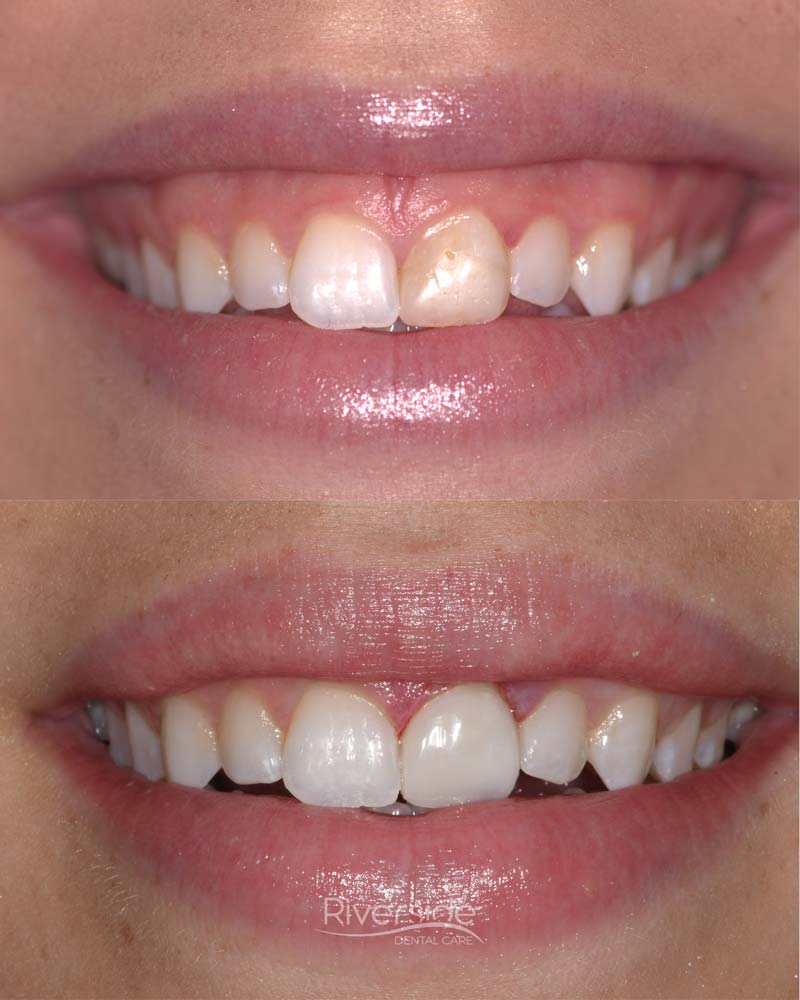
Composite bonding uses tooth-colored resin — the same material used for fillings — applied directly to the surface of your tooth. Your dentist shapes and sculpts it by hand, then hardens it with a curing light.
Because the material is shaped and bonded directly to your tooth, cosmetic bonding can usually be completed in a single appointment
Bonding is versatile. It can help:
- Fix chips and cracks
- Close small gaps
- Cover stains that whitening won’t touch
- Repair slightly misshapen teeth
- Add length to worn-down edges
Done well, bonding looks natural and blends with surrounding teeth.
The trade-off is durability. Composite resin stains more easily than porcelain and does not hold up as long under biting pressure. Most bonding lasts five to ten years before it needs to be refreshed or replaced, depending on where it is in your mouth and how you care for it.
What Are Veneers?
Veneers are thin shells — usually porcelain — custom-made in a dental lab and permanently bonded to the front surface of your teeth.
Because they are fabricated off-site, getting veneers usually takes at least three appointments:
- Take impressions and design your custom veneers.
- Prepare your teeth for veneer placement.
- Place and bond your final veneers.
Porcelain is more durable than composite resin, more stain-resistant, and reflects light in a way that closely mimics natural tooth enamel.
Veneers typically last 15 to 20 years with proper care. They also allow more control over the final result. Shape, shade, and proportion are all determined before anything is permanently placed.
The trade-off is that veneers require removing a thin layer of enamel from your teeth, making the process irreversible. They also cost more per tooth, partly because of the lab work involved.
Veneers vs. Bonding: Quick Comparison
| Category | Composite Bonding | Porcelain Veneers |
| Best For | Minor chips, small gaps, small cosmetic fixes | Larger smile changes, multiple teeth, full smile makeovers |
| Material | Tooth-colored composite resin | Custom porcelain shells |
| Appointments | Usually one visit | Usually three or more visits |
| Durability | Typically 5–10 years | Typically 15–20 years |
| Stain Resistance | More likely to stain over time | Highly stain-resistant |
| Reversibility | Often more conservative and sometimes reversible | Irreversible because enamel is removed |
| Cost | Lower upfront cost | Higher upfront cost |
| Best Fit | Smaller changes or budget-conscious treatment | Longer-lasting, more comprehensive smile improvements |
How to Decide Between Veneers and Bonding
Neither option is universally better. The right choice depends on what you are trying to fix and what matters most to you.
Bonding tends to be the better fit when:
- You are fixing one or two teeth, not transforming a full smile
- The issue is minor, such as a chip, small gap, or single discolored tooth
- You want something done quickly, often in one visit
- You are not ready to commit to a permanent change
Veneers tend to be the better fit when:
- You are treating six or more teeth and want a consistent result across your smile
- You want a longer-lasting solution
- Your teeth have significant discoloration that composite may not cover well
- You want more control over the final shape, shade, and appearance
- You are investing in a full smile makeover
One more thing worth mentioning: veneers and bonding can sometimes be combined.
Some patients use veneers on the front teeth that show most prominently and bonding on teeth that only need minor touch-ups. Your dentist can help you determine which option is best based on the specific teeth you’d like to improve and your overall smile goals.
Cost Differences
Composite bonding typically runs $300 to $800 per tooth.
Porcelain veneers typically run $1,000 to $2,500 per tooth, depending on the dentist, material, and complexity of the case.
The gap is significant if you are treating multiple teeth, but veneers also last two to three times longer. That means the long-term math is not always as lopsided as the upfront numbers make it look.
Financing is available at Riverside Dental if cost is a factor in your decision.
Why Your Dentist’s Skill Matters
This is true for both treatments, but it is worth saying clearly: cosmetic dentistry is technique-sensitive.
Composite bonding done by someone with strong cosmetic training looks different from bonding done by someone who does not focus on cosmetic work. The same is true for veneers.
When it comes to cosmetic dentistry, experience and continuing education matter. At Riverside Dental Care, Dr. Snyder has 19 years of experience helping patients achieve beautiful, confident smiles, and Dr. Stevens is actively pursuing AACD accreditation through the American Academy of Cosmetic Dentistry—one of the highest distinctions in the field. Together, they bring a thoughtful, detail-oriented approach to cosmetic care.
Next Step
The best way to figure out which option is right for you is to schedule a consultation.
A cosmetic dentist can look at the specific teeth you are concerned about, show you what is realistic with each approach, and give you an accurate cost estimate.
Riverside Dental Care has two locations in St. George with extended weekday hours.
Schedule a consultation online or call (435) 673-3363.
Share
Recent Posts

July 17, 2026
Let’s See A Post With Formatting Examples
What you are seeing is a standard Text Element. You can add things like bold or italics, you can even strikethrough, underline, or...
July 14, 2026
Veneers vs. Bonding: What’s the Difference?
What Is Composite Bonding? Composite bonding uses tooth-colored resin — the same material used for fillings — applied directly to the surface of...

July 8, 2026
Is Composite Bonding Worth It for Chips, Gaps, or Discoloration?
If you have a chipped tooth, a small gap, a discolored spot, or an edge that does not look quite right, you may...